What Is the Secret to Recovering Your Concrete's Original Shine?
What Is the Secret to Recovering Your Concrete's Original Shine?
Common Causes of Concrete Deterioration
Concrete is an incredibly long lasting and flexible material, commonly utilized in building for its strength and long life. Pressure Cleaning Bundaberg offers expert pressure washing services for residential concrete cleaning company Pressure Cleaning Bundaberg offers a variety of services tailored to residential. Nevertheless, like all products, it is not unsusceptible to the ravages of time and environmental variables. Recognizing the usual reasons for concrete degeneration is the initial step in restoring your concrete's initial appeal and ensuring its long life.
One significant cause of concrete degeneration is the freeze-thaw cycle. Concrete is porous, which implies it can soak up water. In colder climates, this soaked up water can freeze and expand, creating the concrete to fracture and spall. Over time, repeated freeze-thaw cycles will substantially deteriorate the concrete, leading to surface destruction and a loss of visual charm.
Another prevalent concern is chemical assault, especially from de-icing salts utilized on roadways and sidewalks. These salts can pass through the surface area of the concrete and react with its parts, resulting in scaling, flaking, and the rust of strengthening steel within. This not just lessens the aesthetic allure of the concrete yet likewise jeopardizes its architectural honesty.
Additionally, bad building methods can speed up concrete damage. Insufficient blending, incorrect treating, or insufficient insurance coverage of reinforcement can cause very early failing. These methods can create weak points in the concrete that are more prone to environmental damages and chemical strike.
To restore your concrete's original appeal, addressing these underlying issues is vital. Start by examining the level of the damage and identifying the origin. For freeze-thaw damages, take into consideration applying a sealant or a concrete overlay to safeguard the surface area and avoid more water seepage. If chemical attack is the wrongdoer, getting rid of the polluted surface and applying a safety coating can help recover the concrete's appearance and secure against future damage.
In situations where inadequate building and construction methods have resulted in degeneration, much more extensive repair work might be necessary. This can entail eliminating and replacing broken areas or applying strengthening materials to boost structural honesty.
Ultimately, recurring upkeep is crucial to preserving the brought back appeal of your concrete. Routine cleaning, prompt fixings of tiny splits and chips, and the application of protective sealants can help fend off future deterioration.
Finally, recognizing the usual sources of concrete damage is important for efficient reconstruction. By dealing with these problems and carrying out preventive measures, you can bring back and protect your concrete's initial appeal and performance, ensuring it stands the test of time.
Importance of Regular Cleaning Up
Concrete is a sturdy and functional product commonly utilized in various building applications, from driveways and patios to interior floorings. Gradually, nonetheless, concrete surface areas can shed their initial luster due to direct exposure to the aspects, foot web traffic, and various other ecological elements. Among the crucial secrets to recovering and keeping the initial gloss of concrete is normal cleaning.
Routine cleansing works as the foundation for maintaining any type of concrete surface, stopping the buildup of dust, grime, and stains that can stain its look. Concrete, while durable, is permeable and can take in substances that result in staining and deterioration over time. By applying a routine cleansing program, you can considerably decrease the risk of these concerns and expand the life of your concrete surface.
The very first step in normal concrete cleansing is to remove loose particles and dirt, which can be achieved via basic sweeping or using a leaf blower. This first action stops abrasive particles from the ground up the surface area when extra thorough cleansing techniques are used. Following this, a mild clean with water can assist remove surface-level dirt and dust. For more stubborn spots, a light cleaning agent or specialized concrete cleaner can be made use of. These products are designed to penetrate the permeable surface of concrete and lift deep-rooted stains without creating damage.
An additional critical facet of preserving concrete's radiance is attending to spills and spots immediately. Whether it's oil, grease, or other compounds, instant interest can prevent long-term discoloration. Utilizing absorbent products like feline clutter or baking soda can help soak up spills, while a mixture of water and vinegar can be effective for eliminating mild discolorations. For tougher discolorations, a pressure washing machine could be needed. However, caution ought to be exercised to avoid damaging the concrete with too much pressure.
In addition to regular cleansing, sealing the concrete is a superb means to protect its look. Sealers work as a safety obstacle, reducing the concrete's permeability and making it a lot more resistant to spots and weathering. Frequently reapplying a sealer, as advised by the maker, can keep your concrete looking brand-new for longer.
Finally, routine assessments of your concrete surface areas can aid determine prospective problems early. Cracks or chips can be fixed before they get worse, making certain that the surface continues to be even and aesthetically pleasing. Addressing these issues without delay not only protects the appearance however additionally improves the architectural stability of the concrete.
To conclude, the trick to recovering and preserving your concrete's initial radiance lies in the relevance of routine cleaning. By developing a regular cleansing regimen, dealing with spills and discolorations quickly, securing the surface, and carrying out routine
Reliable Cleaning Up Techniques for Concrete
Bring back concrete to its initial radiance requires a blend of efficient cleaning strategies, the appropriate products, and a little bit of persistence. Concrete, a long lasting and versatile material, is typically based on extreme ecological conditions, spills, and put on that can dull its look with time. To bring back its initial luster, recognizing the nature of concrete and the ideal cleansing approaches is vital.
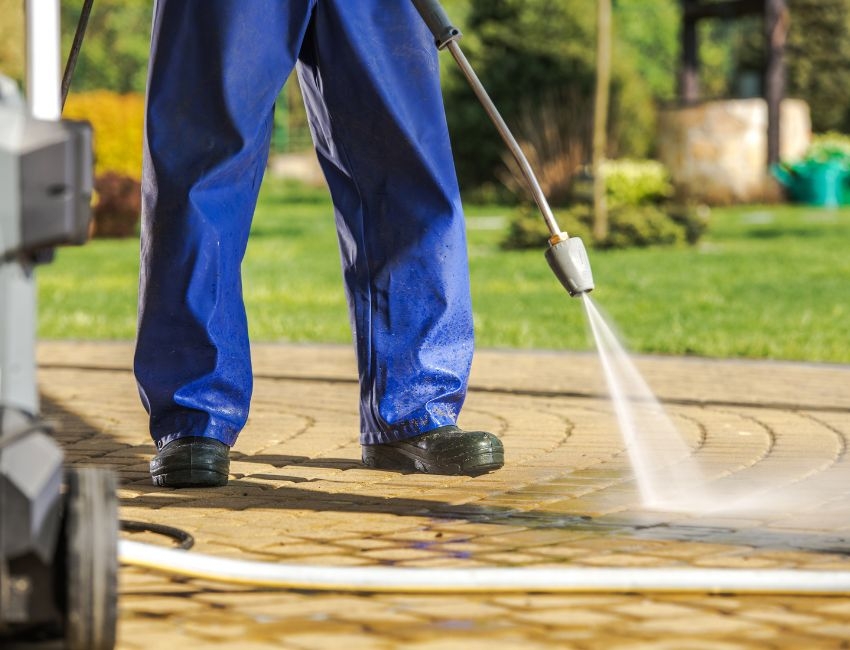
First, it is necessary to examine the present problem of the concrete. Determine whether it has spots, mold, or just accumulated dust. Each of these issues requires a various method. For general dirt and gunk, a basic move adhered to by a thorough pressure laundry can be exceptionally effective. Pressure cleaning is among the most preferred strategies, as it utilizes high-pressure water to displace dirt and crud embedded in the concrete's porous surface. Nonetheless, it is vital to make use of the ideal pressure setting to prevent damaging the concrete.
For spots, such as oil or oil, a more targeted method is required. Commercial concrete cleansers are specifically formulated to break down these tough spots. Applying a degreaser or a specialized cleaner and rubbing with a stiff-bristled brush can lift the stains efficiently. In many cases, making use of a poultice-- a paste made from a cleaning agent and an absorbent product-- can extract deep spots. The key is to allow the plaster rest for the suggested time before wiping it away.
Mold and mildew and mold, which prosper in moist environments, can also be a problem for concrete. Utilizing a remedy of water and bleach or a specialized mold and mildew cleaner can remove these unpleasant developments. Always ensure correct ventilation and use safety equipment when managing strong chemicals to safeguard both your health and the environment.
When the concrete is clean, securing it is a crucial step to keep its restored look. A top quality concrete sealer not only enhances the color and appeal but likewise provides a protective obstacle versus future discolorations and damage. There are different sorts of sealants, from permeating sealants which offer protection without transforming the surface look to topical sealants that can add a glossy or damp appearance.
Ultimately, maintaining the concrete's radiance involves routine cleansing and resealing as needed. Including a gentle cleaning routine, such as sweeping away debris and immediately cleansing spills, can extend the life of the sealant and maintain the concrete looking its best.
In conclusion, the secret to restoring your concrete's original gloss hinges on recognizing the certain issues influencing it and applying the proper cleaning strategies. From stress cleaning and stain elimination to
Choosing the Right Sealer for Concrete
Bring back concrete to its initial luster can revive exhausted, worn surface areas, changing them right into captivating functions that boost the total aesthetic of a residential property. The key to accomplishing this rejuvenated look depends on picking the best sealant for your concrete, a selection that can dramatically affect the toughness and visual appeal of the surface area.
Concrete, while inherently solid and resilient, is permeable and vulnerable to damage from environmental elements such as moisture, UV rays, and temperature level fluctuations. Gradually, these components can trigger concrete to crack, tarnish, and shed its initial shine. To restore its appeal, the application of an appropriate sealer is vital.
The first step in choosing the best sealer is understanding the particular requirements of your concrete surface area. Various kinds of sealants provide varying degrees of protection and coating, each made to satisfy certain conditions and desired results. As an example, if the concrete is subjected to heavy foot website traffic or automotive tons, a more durable sealant like an epoxy or polyurethane might be excellent as a result of their high toughness and resistance to abrasion.
For outside concrete surfaces, such as driveways or patios, it is essential to choose a sealer that uses security versus UV rays and water penetration. Polymer sealants are popular for these applications, as they provide a safety obstacle while improving the shade and structure of the concrete. They are additionally fairly very easy to apply and preserve, making them a sensible option for homeowners seeking to revitalize their outdoor areas.
On the various other hand, if the objective is to draw out the all-natural beauty of the concrete while supplying a wet, shiny appearance, permeating sealants like silanes or siloxanes may be better suited. These sealers work by penetrating the surface area and developing a chemical bond within the concrete, using superb protection against dampness without changing the appearance also considerably.
An additional factor to consider is the ecological impact and safety and security of the sealer. Choosing low-VOC (volatile organic substance) sealers can reduce harmful emissions and contribute to a much healthier indoor or outside setting.
Eventually, the key to restoring your concrete's original appeal lies in a thoughtful selection of sealant based on the certain needs and conditions of the surface. By evaluating variables such as direct exposure to aspects, desired coating, and ecological factors to consider, you can choose a sealant that not only rejuvenates your concrete but additionally guarantees its durability and strength. With the appropriate sealer, your concrete can reclaim its initial appeal, enhancing both the functionality and charm of your property.
Repairing Splits and Surface Area Damage
Concrete is a staple in contemporary building, renowned for its durability and strength. Nonetheless, with time, even one of the most robust concrete surfaces can succumb to the effects of weather condition, wear, and other outside pressures. Splits and surface area damage not only mar the aesthetic charm of concrete however can likewise jeopardize its architectural integrity. Restoring your concrete to its original gloss entails a combination of repair work methods and preventive measures that safeguard versus future wear and tear.
The very first step in bring back concrete is to analyze the degree of the damage. Little cracks and surface area imperfections can commonly be fixed with a straightforward patching compound. These compounds are created to fill out spaces and develop a smooth surface, properly concealing the flaws. They are readily available in various formulations, some of which are customized for specific types of damage or ecological conditions. As an example, particular products are preferable for locations that experience regular freeze-thaw cycles, offering versatility and resilience versus growth and contraction.
For bigger or more extreme splits, an extra thorough strategy might be essential. This can involve making use of a concrete resurfacer, a specialized mix that bonds to the existing surface, creating a new, sturdy layer. Resurfacing not just fixings damage but additionally rejuvenates the look of the concrete, giving it a fresh, consistent appearance. It is essential to extensively tidy and prepare the surface prior to using any resurfacing product, as impurities like oil, dirt, or old paint can hinder the bonding process.
One of the tricks to restoring concrete's original gloss hinges on the ending up touches. After fixing fractures and resolving surface damage, applying a concrete sealant can protect the surface from future harm. Sealers serve as an obstacle versus moisture, chemicals, and UV rays, every one of which can add to the degradation of concrete in time. They also improve the look of the concrete, providing it a shiny or matte surface depending on the product picked.
Upkeep is an additional important component in protecting the appeal and durability of concrete surfaces. Regular cleansing and assessments can aid determine possible concerns before they develop into significant troubles. Furthermore, immediately addressing any type of new fractures or damages can stop them from rising, thus extending the life of the concrete.
To conclude, the key to restoring your concrete's initial luster is a combination of efficient repair service methods and thorough upkeep. By addressing cracks and surface damages quickly, using top notch materials, and using protective sealers, you can invigorate your concrete surface areas and guarantee they remain beautiful and functional for years ahead. With the best technique, also one of the most weather-beaten
Tips for Long-term Concrete Preservation
Concrete is among the most resilient and reliable materials utilized in building and construction, yet with time, even this unwavering material can lose its initial luster. Elements such as ecological exposure, chain reactions, and mechanical wear can bring about a loss of aesthetic charm and architectural stability. Recovering your concrete to its initial state calls for a combination of maintenance, defense, and restoration methods. Below is a guide to help you maintain your concrete for the long term and restore its initial radiance.
To start with, regular cleansing is crucial for maintaining concrete's look and longevity. Dirt, gunk, and stains can accumulate externally, altering its look and potentially causing wear and tear. Use a power washing machine or a tube with high stress to remove surface particles. For discolorations, take into consideration utilizing a moderate detergent or a specialized concrete cleaner. Guarantee you rinse thoroughly to prevent soap deposit from bring in more dust.
Securing is another crucial action in maintaining your concrete. Sealers act as a safety obstacle versus wetness, chemicals, and wear. They assist avoid water penetration, which can cause fracturing and spalling due to freeze-thaw cycles. Choose a high-quality sealant proper for your details type of concrete and its exposure problems. Consistently reapplying the sealer, commonly every couple of years, will maintain its safety benefits.
Dealing with fractures and damage immediately can avoid much more substantial damage. Tiny fractures can quickly become larger if left unattended, bring about significant structural issues. Use a concrete repair work substance to fill splits and gaps as quickly as they show up. For bigger repairs, think about employing a specialist to make sure the stability of the structure is not compromised.
Along with these upkeep actions, adopting safety nets can dramatically boost the durability and appearance of your concrete. Prevent making use of de-icing chemicals in winter months, as they can intensify freeze-thaw damage. Instead, use sand or kitty litter for traction. In a similar way, beware with lawn fertilizers and various other chemicals that can tarnish or harm the concrete surface area.
Lastly, for those wanting to bring back concrete's original gloss, think about resurfacing therapies. These include applying a thin layer of new concrete or a polymer-modified finish over the existing surface. This procedure can cover discoloration, small flaws, and put on, giving your concrete a fresh, lively look. Sprucing up is one more option that involves grinding the surface area to accomplish a smooth, shiny coating, suitable for indoor areas or attractive applications.
In conclusion, the key to bring back and preserving your concrete's initial appeal lies in consistent upkeep, defense, and prompt repairs
Bundaberg Pressure Cleaning offers professional pressure washing services throughout the Wide Bay-Burnett region, catering to both residential and commercial clients. Their comprehensive range of services includes house and driveway cleaning, as well as roof and deck restoration. They meticulously care for various surfaces, including timber, concrete, brick, and stone, ensuring each one receives expert treatment. The skilled team utilizes state-of-the-art equipment and effective techniques to revitalize and safeguard properties, enhancing curb appeal and increasing overall property value.
For homeowners, Bundaberg Pressure Cleaning offers more than just basic cleaning services. Regular pressure washing can significantly extend the lifespan of outdoor materials by preventing harmful buildup that might result in expensive repairs. For instance, roof cleaning effectively removes grime, mold, and algae, which can compromise structural integrity if not addressed. Additionally, their deck and outdoor space cleaning revitalizes these areas, eliminating stubborn dirt and mold, creating safe and welcoming environments for gatherings and relaxation.
Bundaberg Pressure Cleaning provides customized cleaning solutions for commercial clients, specifically designed to meet the demands of high-traffic areas. They cater to a diverse array of commercial properties, including warehouses, storefronts, office buildings, and sports facilities. Their skilled team adeptly addresses tough stains, grease, and mold in parking lots, driveways, and other public spaces, ensuring a polished and professional appearance. Furthermore, they offer sanitation services to assist businesses in maintaining cleanliness following incidents like flooding or sewage leaks, fostering a healthy environment for both employees and visitors.
With a strong commitment to quality and eco-friendly practices, Bundaberg Pressure Cleaning has established a solid reputation for reliability and professionalism. They utilize safe, sustainable cleaning solutions that achieve outstanding results while being mindful of the environment. Their well-trained team is capable of managing projects of any scale, consistently providing prompt and affordable service. Whether you need routine property maintenance, preparation for a sale, or comprehensive commercial cleaning, Bundaberg Pressure Cleaning is the trusted choice in the Wide Bay-Burnett region. For a free quote, call (07) 4158 8067 today!
About Bundaberg
For other uses, see Bundaberg (disambiguation).
City in Queensland, Australia
Bundaberg Queensland
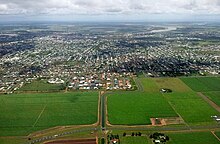
(From left to right) Aerial view of Bundaberg and the Burnett River, Bundaberg Post Office and Bundaberg War Memorial, Hinkler House in the Bundaberg Botanic Gardens, Bundaberg Regional Art Gallery, Historic architecture along Bourbong street, Bundaberg Rum Distillery, South Sea Islander wall
Bundaberg (/ˈbʌndəbɜːrɡ/) is a city in the Bundaberg Region, Wide Bay, Queensland, Australia, and is the tenth largest city in the state.[2] It is a major centre of the Wide Bay–Burnett geographical region. The Bundaberg central business district is situated along the southern bank of the Burnett River, about 20 km (12 mi) from its mouth at Burnett Heads, and flows into the Coral Sea.[3] The city is sited on a rich coastal plain, supporting one of the nation's most productive agricultural regions. The area of Bundaberg is the home of the Taribelang-Bunda, Goreng Goreng, Gurang, and Bailai peoples.[4][5] Popular nicknames for Bundaberg include "Bundy", "Rum City", and "The 'Berg". The demonym of Bundaberg is Bundabergian.[citation needed] In the 2021 census, Bundaberg's urban area has a population of 73,747 people.[1][6]
The district surveyor, John Thompson Charlton designed the city layout in 1868, which planned for uniform square blocks with wide main streets, and named it ‘Bundaberg’.[7] An early influence on the development of Bundaberg came with the 1868 Land Act, which was a famous Queensland via media, that aimed to create a class of Australian yeoman.[8] Large sugarcane plantations were established throughout the 1880s, with industries of sugar mills, refineries, and rum distilleries that delivered prosperity to Bundaberg.[9] These plantations used South Sea Islanders as indentured labourers, many of whom were blackbirded, a practice considered of form of slavery.[10][11] The trade was outlawed in 1904, with most South Sea Islanders deported by 1906.[12] Major floods in 1942 and 1954 damaged the river, ending Bundaberg's role as a river port and led to a new port at the mouth of the Burnett river.[13] In the post-war era, Bundaberg continued to grow with its wealth tied to its sugar industry.[14] In 2013, Bundaberg experienced record flooding from Cyclone Oswald, which was the worst disaster in the city's history.[15]
The economy of Bundaberg is based primarily on agriculture, forestry, fishing and tourism, with a gross regional product at about $5.6 billion as of 2023.[16] Bundaberg also has a major distillery and brewery industry that exports to international markets.[17] The city is served by the Port of Bundaberg and the Bundaberg Airport.
Bundaberg has a rich history and culture, along with its humid subtropical climate it is known for its weeping fig trees, dry stone walls, and historic plantations, including the Fairymead Plantation and the Sunnyside Sugar Plantation, the latter of which is the site of a mass grave.[18] Other sites of South Sea Islander cultural significance include Sir Anthony's Rest atop the Bundaberg Hummock and the South Sea Islander Church. Major cultural institutions include the Hinkler Hall of Aviation and the Bundaberg Regional Art Gallery. The city's culinary culture is highlighted by its annual 'Banquet on the Bridge',[19] and an iconic rum and gin culture with Bundaberg Rum originating in the city.
Bundaberg is a popular tourism destination, the city's hinterland includes the historic towns of Childers and Gin Gin, Lake Monduran, Cania Gorge National Park and the Promisedland mountain bike trails. Bundaberg's coastal areas include Bargara and Mon Repos, Deepwater National Park, and the southernmost reaches of the Great Barrier Reef alongside the islands of Lady Musgrave and Lady Elliot.
Geography
[edit]
The city is about 385 kilometres (239 mi) north of the state capital, Brisbane. It is 15 kilometres (9.3 mi) inland from the Coral Sea coast and situated on the Burnett River.
Etymology
[edit]
City name
[edit]
The name was coined by surveyor John Charlton Thompson and his assistant Alfred Dale Edwards. Bunda was derived from the name of one of the kinship groups of the local Taribelang people, and appended with the suffix "berg". Two sources of the suffix have been proposed. It is a Saxon suffix which means "hill".[20] It is also a German word which translates as "mountain", and refers to the Sloping Hummoch, the singular hill rising above the relatively flat region surrounding the Burnett River on which the city is situated.
Colloquially, the city is widely known throughout Australia as "Bundy". Residents are referred to by the demonym Bundaberger, and the corresponding adjective is Bundabergian.
Bourbong Street
[edit]
Bourbong Street is the main street of the city. and there is some controversy in regards to its spelling and meaning. Bourbong was alternatively spelled Bourbon or Boorbong, which was a local Aboriginal title given to a large waterhole in the area.[21] The main street was historically also gazetted in the Bundaberg Mail as "Bourbon" street, but by 1941 there is no reference to "Bourbon" street. Robert Strathdee's farming selection in the vicinity of the watering holes was recorded on early survey maps as 'Boorbung'.[22]
A pioneer pastoralist of the region, Nicholas Tooth, wrote that "Bourbong" was derived from the local Aboriginal phrase "bier rabong", meaning "plenty dead". Tooth, who took up land in the area in the early 1860s, found that Aboriginal people resolutely avoided the "bier rabong" vicinity. He later found the skeletal remains there of around twenty Aboriginal people who were apparently massacred in a raid by the Native Police.[23]
History
[edit]
Burnett River
Early history
[edit]
The Traditional owner Aboriginal groups in the region are the Taribelang, Gooreng Gooreng, Gurang, and Bailai peoples. They are the original inhabitants of the region.[24] A determination of Native Title was made for all four cultural groups by the National Native Title Tribunal, pursuant to the Native Title Act 1993, on 28 November 2017.[25] It was determined that "native title exists in the entire determination area" of Bundaberg, Gladstone, and the North Burnett.
As such, the Bundaberg Regional Council has reflected this recognition in their "First Nations Strategy 2022-2026", and endeavours to celebrate and embrace the region's "local connections to First Nation Peoples and other cultures".[26]
Initial British colonisation
[edit]
The first British man to visit the area was James Davis in the 1830s. He was an escaped convict from the Moreton Bay Penal settlement who lived with the Kabi people to the south of the region. He resided mostly around the Mary River and was referred to as Durrumboi.[27] The Burnett River was surveyed by John Charles Burnett, after whom it was named during his exploration mission of the Wide Bay and Burnett regions in 1847.[28][29]
British occupation of the land in the region began in 1848 when pastoral squatters Gregory Blaxland Jnr and William Forster established a sheep station. Blaxland was a son of the Blue Mountains explorer, Gregory Blaxland, and Forster was later to become a Premier of New South Wales. They selected a very large area of land which encompassed most of the western part of the modern day Bundaberg Region along the Burnett River. They named this pastoral lease Tirroan.
Blaxland and Forster had previously set up sheep stations near the Clarence River and had a notable history of conflict with Aboriginal people.[30] Sheep stations imposed on native bushland disrupt native food production, typically resulting in widespread hunger and illness amongst native peoples. Conflict continued at Tirroan when two of their shepherds were killed by Aboriginal people in 1849. Forster and Blaxland led a punitive expedition causing multiple Aboriginal deaths. Further conflict occurred the following year when Blaxland was clubbed to death. Forster and a number of other squatters conducted another reprisal, resulting in a large massacre of Aboriginal people in scrubland toward the coastal part of Tirroan.
In the early 1850s, Forster sold the property to Alfred Henry Brown who changed the name of the pastoral lease to Gin Gin. At the same time, Native Police officer, Richard Purvis Marshall, took up the Bingera leasehold in the rainforest scrubland downstream from Tirroan. Three towns in the Bundaberg region, Tirroan, South Bingera and Gin Gin, commemorate these massive initial leaseholds.[31][32]
Sketch of Bundaberg, North Queensland, 1877 (State Library of Queensland)
Cattle and logging
[edit]
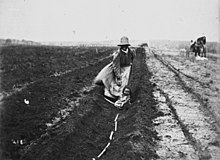
Timber workersSouth Sea Islanders on the deck of a ship arriving in Bundaberg, 1895South Sea Islander woman planting sugar cane in a field, c.1897Promotional float for Paramount Theatre for White Zombie with actors in blackface, Bundaberg ca. 1930s.
Before colonisation, much of the land around the lower reaches of the Burnett River consisted of either the Woongarra Scrub, a subtropical rainforest that stood where most of the Bundaberg canefields now grow, or the Barolin Plains, a lightly timbered grassland that stretched along the coastal fringe. Neither of these areas were suitable for sheep farming but the British soon found that raising cattle was possible. In the early 1860s the first cattle stations in the area were established; Branyan on the south side of the Burnett River and Tantitha on the north side.[32][33]
Timber companies, such as that owned by William Pettigrew, started the logging of the Woongarra Scrub in 1867.[32]
In 1868, Samuel Johnston erected a sawmill in Waterview, on the north bank of the Burnett River.[34][35] The Waterview sawmill became a prominent supplier of timber until its closure in 1903 after being damaged by flood.[36]
Town of Bundaberg
[edit]
In 1867, timber-getters and farmers, John and Gavin Steuart, established the Woondooma property which consisted of a few houses and a wharf on the northern banks of the Burnett River where Bundaberg North now stands.[37][34] An official survey of the area was undertaken in 1869 by John Charlton Thompson,[34] assisted by James Ellwood and Alfred Dale Edwards,[38] and the town of Bundaberg was gazetted across the river on the higher, southern banks. The first Bundaberg land sale was held in Maryborough on 11 May 1870 where hotelier John Foley bought the original lots.[32][39]
Sugar
[edit]
Most of the early settlers exploited the timber and grew maize on their selections but as a result of the incentives of the Sugar and Coffee Regulations of 1864, sugar became a major component in Bundaberg's development from the 1870s. Experimental sugar cane cultivation in the district was first grown at John Charlton Thompson's Rubyanna property in 1870 and the first sugar mill was built by Richard Elliot Palmer at his Millbank plantation in 1872.[40][41] Bundaberg rapidly became an important sugar production region after the construction of the Millaquin Sugar Refinery at East Bundaberg by Robert Cran and his sons in 1882.[42] The Fairymead sugar processing plant owned by the Young Brothers (Arthur, Horace and Ernest Young) opened in 1884 which further augmented Bundaberg's sugar producing capacity.
The initial 35 years of the sugar industry in Bundaberg was reliant on South Sea Islander workers, who were often blackbirded and kept in a status close to slavery. The first significant shipload of Kanaka labour, as it was called, to arrive on the Burnett River came in January 1872 aboard the Petrel.[43] Allegations of kidnapping and wounding immediately arose concerning the recruitment of the Islanders on this vessel.[44] Influential Bundaberg plantation owners were able to purchase recruiting ships in order to obtain labour directly from areas such as the Solomon Islands and the New Hebrides. The Young Brothers owned the Lochiel and the May vessels,[45][46] the Cran family and Frederic Buss were the major investors in the Helena while the Ariel was co-owned by a number of local planters.[47] While some of the recruitment was voluntary, violence and deception toward Islanders often took place. For example, the crew of the Helena fought a battle with the locals of Ambrym while taking Islanders from there.[48]
These labourers had to work for three years and were only paid at the end of this time period. Instead of cash, they usually received substandard goods and trinkets of minimal value as payment.[49] Excessive mortality of the Islanders while serving their term of labour in the Bundaberg region was frequent. Overwork, poor housing, inadequate food, contaminated water supplies and a lack of medical care all contributed to the high death rate. Penalties for the plantation owners whose neglect resulted in these fatalities were rare and did not exceed a £10 fine.[50][51] Importing South Sea Islander labour was made illegal in 1904 and enforced repatriation of these workers out of Bundaberg and other locations in Queensland occurred from 1906 to 1908.[52]
Holy Rosary Catholic Church, Bundaberg, 1939
The 1911 Queensland sugar strike occurred after the phasing out of South Sea Islander labour, with workers claiming that many plantation owners had substituted black indentured labourers (sometimes referred to as slaves) with white ones. Workers sought better accommodation, wages and conditions, including an eight-hour day and a minimum weekly wage of 30 shillings, including food. The mobilisation of unionists from Bundaberg to Mossman was a major achievement, with the 1911 strike lasting over seven weeks in Bundaberg where the town's economy was largely based on the sugar industry.[53] The end result of the strike was a Commonwealth Royal Commission into the sugar industry in 1911–12, which had been initially requested by Harry Hall, a Bundaberg AWA organiser in 1908 with a petition signed by 1500 Bundaberg sugar workers.[54] The Royal Commission, with ALF Secretary Albert Hinchcliffe as secretary, concluded the AWA demands had been justified. The union victory was a watershed in organised labour in Queensland and Australia.[55][56]
Vaudeville marquees on Quay Street on the banks of the Burnett River, 1935
Further progress
[edit]
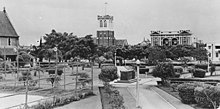
Buss Park vista, the Church of England to the left, and the Presbyterian Church and the Ambulance Building in the background, 1946Bundaberg War Memorial in front of the Bundaberg Post Office, 1948
St Joseph's School opened in June 1876.[57]
With the passage of the Local Authorities Act 1902, Barolin Division became the Shire of Barolin and the Borough of Bundaberg became the Town of Bundaberg on 31 March 1903. On 22 November 1913, Bundaberg was proclaimed a City.[58]
In 1912 Bundaberg pioneering aviator Bert Hinkler built and successfully flew his own glider on Mon Repos beach. He also completed a noteworthy non-stop flight from London to Turin in 1920. The following year in 1921 Hinkler flew from Sydney to Bundaberg, non-stop, in a record breaking flight of 8 and a half hours, in the process beating a telegram he had sent to his mother, to warn her of his arrival.[59]
The Bundaberg War Memorial commemorating those who died in the Anglo-Boer War and World War I was unveiled by Major-General Charles Brand on 30 July 1921.[60][61] The Bundaberg digger was imported from Italy and is constructed of Italian marble. The completed memorial, at a cost of £1,650, was the third most costly to be erected in Queensland. It is a major regional memorial and one of the two most intact digger memorials that remain in their original settings of intersections.
The Bundaberg tragedy of 1928 resulted in the deaths of 12 children in a 24-hour period after they were administered a contaminated diphtheria vaccine.[62]
In 1941 the Sisters of Mercy purchased the house Brabourne (originally owned by prominent citizen Frederick Buss) and established St Mary's Hostel, for women and girls working in or visiting Bundaberg. After World War II, doctors were calling for modern hospital facilities in Bundaberg, so the Sisters converted the hostel into the Mater Private Hospital, a 24-bed hospital with an operating theatre, chapel, and accommodation for the nurses and maids, officially opening on 28 July 1946. The nurses were initially all nuns, but they established a training school for other women to become nurses. The hospital expanded over the years with additional beds, operating theatres, X-ray, pathology and a dedicated children's ward. It was the first hospital in Queensland to use the Zeiss ophthalmic microscope, the first regional hospital in Queensland to have a lymphoedema clinic, and to use facial recognition technology for endoscopic sinus surgery.[63]
In the 1960s the township was completely flooded by the Burnett river. In 1967 Bundaberg celebrated its centenary by producing a coin and opening The Bundaberg and District Historical Museum in the Bundaberg Botanical Gardens in Bundaberg North.
Bundaberg in the 21st century
[edit]
In December 2010, Bundaberg suffered its worst floods in 60 years, when floodwaters from the Burnett River inundated hundreds of homes.[64]
Two years later, in January 2013, Bundaberg experienced its worst flooding in recorded history as a result of Cyclone Oswald. Floodwaters from the Burnett River peaked at 9.53 metres. Over 4,000 properties and 600 businesses had been affected by floodwaters, which moved in excess of 70 kilometres per hour (43 mph).[65] Two defence force Blackhawk helicopters were brought in from Townsville as part of the evacuation operation, which ultimately used an additional 14 aircraft.
On 6 April 2018, Prince Charles visited Bundaberg Rum Distillery[66] He stated, “I'm thrilled that this Distillery's proving to be the one that produces some of the most famous and special of all rums around the world."[66]
In 2018, the Australian Bureau of Statistics estimated the population of Bundaberg's significant urban area was 70,921 people.[67]
Demographics
[edit]
In the 2016 census, the city of Bundaberg had a population of 50,148 people.[68]
In the 2016 Census, there were 69,069 people in Bundaberg (Significant Urban Area). Aboriginal and Torres Strait Islander people made up 4.3% of the population. 81.2% of people were born in Australia. The next most common countries of birth were England 3.2%, New Zealand 1.8%, Philippines 0.7%, South Africa 0.5% and Scotland 0.4%. 88.9% of people spoke only English at home. Other languages spoken at home included Mandarin 0.5%, Italian 0.4%, German 0.3%, Afrikaans 0.2% and Tagalog 0.2%. The most common responses for religion were No Religion 26.3%, Catholic 18.7% and Anglican 18.6%.[69]
In the 2021 census, Bundaberg's urban area has a population of 73,747 people.[1][6]
Heritage listings
[edit]
Aerial view from the west
Bundaberg has a number of heritage-listed sites, including:
Corner of Bargara Road and Zeilke Avenue, Kalkie: Kalkie State School[70]
Bourbong Street, Bundaberg Central: Bourbong Street Weeping Figs[71]
Bourbong Street, Bundaberg Central: Bundaberg War Memorial[72]
Bourbong Street, West Bundaberg: Bundaberg War Nurses Memorial[73]
Bourbong Street between Bundaberg Central and Bundaberg East: Kennedy Bridge[74]
155a Bourbong Street: Bundaberg Post Office[75]
184 Bourbong Street, Bundaberg Central: Bundaberg School of Arts[76]
Cnr Woongarra and Maryborough streets, Bundaberg Central: Christ Church, Bundaberg[90] The church sits adjacent to Buss Park which contains a memorial to Bert Hinkler.
Climate
[edit]
Bundaberg has a warm humid subtropical climate (Köppen: Cfa) with hot, wet summers and very mild, dry winters. Mean maximum temperatures are high for most of the year, from 22.3 °C (72.1 °F) in July to 30.4 °C (86.7 °F) in January. Annual rainfall averages around 997.0 millimetres (39.25 in), with a strong summer maximum and winter minimum.[91] Extreme temperatures ranged from −0.7 °C (30.7 °F) on 16 July 1918 to 40.2 °C (104.4 °F) on 19 December 1901.[92]
Climate data for Bundaberg (24º54'36"S, 152º19'12"E, 31 m AMSL) (1942-2024 normals, extremes 1892-2024)
Month
Jan
Feb
Mar
Apr
May
Jun
Jul
Aug
Sep
Oct
Nov
Dec
Year
Record high °C (°F)
38.9 (102.0)
38.6 (101.5)
38.5 (101.3)
34.9 (94.8)
31.7 (89.1)
29.7 (85.5)
29.0 (84.2)
31.1 (88.0)
36.5 (97.7)
35.8 (96.4)
37.7 (99.9)
40.2 (104.4)
40.2 (104.4)
Mean daily maximum °C (°F)
30.4 (86.7)
30.2 (86.4)
29.4 (84.9)
27.6 (81.7)
24.9 (76.8)
22.7 (72.9)
22.3 (72.1)
23.6 (74.5)
25.7 (78.3)
27.2 (81.0)
28.6 (83.5)
29.7 (85.5)
26.9 (80.4)
Mean daily minimum °C (°F)
21.5 (70.7)
21.4 (70.5)
20.2 (68.4)
17.6 (63.7)
14.2 (57.6)
11.6 (52.9)
10.3 (50.5)
10.9 (51.6)
13.7 (56.7)
16.6 (61.9)
18.8 (65.8)
20.6 (69.1)
16.5 (61.6)
Record low °C (°F)
14.1 (57.4)
12.2 (54.0)
9.7 (49.5)
6.7 (44.1)
3.3 (37.9)
0.7 (33.3)
−0.7 (30.7)
0.6 (33.1)
0.2 (32.4)
5.5 (41.9)
7.9 (46.2)
10.6 (51.1)
−0.7 (30.7)
Average precipitation mm (inches)
167.3 (6.59)
154.1 (6.07)
111.7 (4.40)
55.8 (2.20)
66.3 (2.61)
48.3 (1.90)
39.3 (1.55)
32.5 (1.28)
34.1 (1.34)
78.0 (3.07)
86.5 (3.41)
123.6 (4.87)
997.0 (39.25)
Average precipitation days (≥ 1.0 mm)
7.9
8.0
7.0
4.9
4.6
3.4
3.1
2.8
2.9
5.1
5.6
6.2
61.5
Average afternoon relative humidity (%)
61
62
59
57
54
52
49
47
49
54
57
60
55
Average dew point °C (°F)
20.1 (68.2)
20.2 (68.4)
18.5 (65.3)
16.2 (61.2)
12.8 (55.0)
10.6 (51.1)
8.8 (47.8)
9.0 (48.2)
11.5 (52.7)
14.6 (58.3)
16.9 (62.4)
18.6 (65.5)
14.8 (58.7)
Source: Bureau of Meteorology (1942-2024 normals, extremes 1892-2024)[93][94]
Suburbs of Bundaberg
[edit]
Aerial view to the north
Avenell
Avoca
Branyan
Bundaberg Central
Bundaberg East
Bundaberg North
Bundaberg South
Bundaberg West
Kalkie
Kepnock
Millbank
Norville
Svensson Heights
Thabeban
Walkervale
Increasing population in Bundaberg is extending residential development into rural localities, such as Ashfield.[95]
Economy
[edit]
Looking down Bourbong Street, Bundaberg town centre.Bundaberg town centre with Bundaberg General Post Office to the right.Young woman riding on the back of a turtle at Mon Repos Beach, near Bundaberg, ca. 1930.
Subtropical Bundaberg is dependent to a large extent on the local sugar industry. Extensive sugar cane fields have been developed throughout the district. Value-adding operations, such as the milling and refinement of sugar, and its packaging and distribution, are located around the city. A local factory that manufactured sugar-cane harvesters was closed down after it was taken over by the US multinational corporation Case New Holland. Most of the raw sugar is exported.[41] A bulk terminal for the export of sugar is located on the Burnett River east of Bundaberg. Recent years have seen the reduction of cane farms and in turn increase of Macadamia farms, whoms main market is China.
Another of the city's exports is Bundaberg Rum, made from the sugar cane by-product molasses. Bundaberg is also home to beverage producer Bundaberg Brewed Drinks Vintage Soda, Craft Brewery Ballistic Brewing Company and Craft Distillery's Waterview Distillery and Kalki Moon.
Commercial fruit and vegetable production is also significant: avocado, banana, bean, button squash, capsicum, chilli, citrus, cucumber, custard apple, egg fruit, honeydew melon, lychee, mango, passionfruit, potato, pumpkin, rockmelon, snow peas, stone fruit, sweet corn, sweet potato, tomato, watermelon, zucchini.[96] Macadamia nuts are also grown.[97] Due to the year-round farm work available in Bundaberg, the city has a high number of working hostels for backpackers looking to extend their working holiday visa in Australia. The hostels provide backpackers with work on farms across the Bundaberg area. However, the hostels and farms have received huge criticism in the press and on social media due to the treatment some backpackers have faced.[98][99] The Courier-Mail have reported claims of poor living conditions, underpayment and allegations of sexual abuse which they say has led to backpackers warning others about working hostels in Bundaberg.[100]
Because of its high rate of unemployment, Bundaberg has been referred to as the "dole capital of Australia".[101]
Tourism
[edit]
Tourism is an important industry in Queensland, and Bundaberg is known as the 'Southern Gateway to the Great Barrier Reef'.[34] The city lies near the southern end of the reef in proximity to Lady Elliot and Lady Musgrave Islands. The nearby town of Bargara is an increasingly popular holiday and retirement destination.
Bundaberg Rum Tours
Nearby beaches are popular with both locals and tourists.[102] Moore Park Beach, to the city's north, has 20 kilometres (12 mi) of golden sandy beach. Beaches on the southern side of the Burnett River are (from north to south) the Oaks Beach, Mon Repos, Nielson Park,[103] Bargara Beach, Kellys Beach, Innes Park and Elliott Heads.
Cania Gorge National Park, Deepwater National Park, Eurimbula National Park and Kinkuna National Park, located in the Bundaberg region are popular with campers and bush-lovers.[102]
Tours of the Bundaberg Rum distillery and attractions at Bundaberg Botanic Gardens, such as the 2 ft narrow gauge[104] Australian Sugar Cane Railway, are also popular with tourists.[102] The Mystery Craters, 35 unexplained water-filled holes in the ground, discovered in 1971 at South Kolan, are also a tourist attraction.[105]
Opened in 2002 by the former member for Hinkler Paul Neville, the Tom Quinn Community Centre gardens (a multiple "Bundy in Bloom" winner) is a site to be seen with local flora and fauna, its own cafe, marketplace, chapel, green house, training facilities, woodwork and indigenous nature section.[106]
Opened in December 2008, the Hinkler Hall of Aviation is an historical aviation tourist attraction that celebrates pioneer solo aviator Bert Hinkler. In 1928, Hinkler was the first person to fly solo from England to Australia.[107] The museum includes an exhibition hall, featuring multi-media exhibits, a flight simulator, a theatre, five aircraft and the historic Hinkler House.
Other local attractions and events include the Whaling Wall, East Bundaberg Water Tower, Baldwin Swamp Environmental Park, Alexandra Park Zoo, Buss Park, Barrell House, Bundy in Bloom, Whale watching, reef tours of Lady Musgrave & Lady Elliiot islands, the Bundaberg Show, Bundaberg & Childers Regional Art Galleries, the Bundaberg Gliding school, Fishing Charters, the Bundaberg International Air Show, and the Woongarra Marine Park.
Bundaberg has ghost tours.[108][109]
Museums and galleries
[edit]
The Bundaberg region contains a variety of museums and art galleries that showcase the region's history and culture.[110]
Hinkler Hall of Aviation
Hinkler House
Fairymead House and Sugar History Museum
BRAG, the Bundaberg Regional Art Gallery
CHARTS, the Childers Art Space
Bundaberg and District Historical Museum
Bundaberg Railway Museum
Bundaberg Rum Distillery Tours[111]
Bundaberg Botanic Gardens containing the 'Hinkler Hall of Aviation', 'Hinkler House', 'Fairymead House' and the 'Bundaberg Steam Tramway Preservation Inc.'
Mystery Craters in South Kolan
Schmeider's Cooperage (Bundy Kegs)
Bundaberg Ginger Beer
South Kolan Mystery CratersBundaberg Rum Factory, Bundaberg
Memorials
[edit]
Bundaberg War Memorial
Hinkler Memorial
Culture
[edit]
Arts and entertainment
[edit]
Bundaberg has two cinemas. The Reading Cinemas, on Johanna Boulevarde, west Bundaberg, and the Moncrieff Entertainment Centre (formerly known as the Moncrieff Theatre), located on Bourbong Street, central Bundaberg. The Moncrieff Entertainment Centre also holds live musical and theatrical performances year round.[112]
The Bundaberg Regional Art Gallery (BRAG) is a large multi-purpose visual arts facility located in central Bundaberg.[113] The Bundaberg Regional Council operates a public library at 49 Woondooma Street.[114]
Media
[edit]
The NewsMail newspaper is published in Bundaberg from Monday to Saturday. It is available in print and online.[115]
Several community newspapers are also available including the Guardian,[116] The Bugle[117] & the Bundaberg Coastline[118]
ABC Local Radio: Wide Bay 855 AM/100.1 FM – due to the terrain of the area, both AM and FM frequencies are used.
4BU 1332 AM (commercial) – owned by Grant Broadcasters
Triple M 93.1 (commercial) – part of the Triple M Network, owned by Southern Cross Media Group .
Hitz FM 93.9 (commercial) – owned by ARN
Breeze 102.5 (commercial) Wide Bay
Rebel 106.7 (commercial) Wide Bay
4BCR 94.7 FM (community)
4DoubleB 96.3 FM (community)
Kix Country 97.1 FM (narrowcast) – owned by Grant Broadcasters
RadioTAB 95.5 FM (narrowcast) – owned by Tatts Group
ABC Classic FM 98.5 FM
Triple J 99.3 FM
ABC Radio National 100.9 FM
Bundaberg is served by three commercial television stations (Seven Queensland, WIN Television and 10) and publicly owned services (ABC TV) and (SBS).
Local news coverage of Bundaberg and the Wide Bay is provided on all three commercial networks with both Seven News and WIN Queensland's WIN News half-hour bulletins airing at 5:30 each weeknight. Southern Cross Austereo also airs brief local news & weather updates at various intervals throughout the day on Channel 10.
Popular culture
[edit]
The city has featured in several films:
The Delinquents (1989), starring Kylie Minogue, which was set in Bundaberg, but partly shot in Brisbane[citation needed]
The Mango Tree (1977)[citation needed]
Talking Back at Thunder (2014), starring Steven Tandy[citation needed]
Flathead (2024), a docufiction film directed by Jaydon Martin[119][120][121]
Sport
[edit]
Mitchell Langerak, former Bundaberg footballer, who is now playing for Nagoya Grampus in the J1 League
Most major Australian sporting codes are played in Bundaberg.
Australian rules
[edit]
Bundaberg has two current clubs playing in the AFL Wide Bay competition.
Across The Waves Bundaberg Eagles (merger of North Bundaberg and Souths/ATW Magpies)
Brothers Bulldogs (formerly West Bundaberg)
Basketball
[edit]
Bundaberg has two professional teams competing in the ConocoPhillips Central Queensland Cup. They are the Bundaberg Autobarn Bulls (men) and Bundaberg Bears (women) and both feature local players.
Rowing
[edit]
Bucca Weir, west of Bundaberg, is an eight lane rowing course home to Bundaberg Rowing Club. It hosts the Queensland School's Championship Regatta each year in September, as well as numerous local regattas.[122]
Rugby league
[edit]
The Bundaberg Rugby Football League is a nine-club competition run under the Queensland Rugby League's Central Division. Bundaberg competes in the Central Division's 47th Battalion Shield and the Bundaberg Grizzlies formerly competed in the Queensland Cup statewide competition.
Soccer
[edit]
The Bundaberg Soccer Football Association was formed at the Grand Hotel on 1 May 1923.[123] In 2023 Bundaberg Football will celebrate the centenary of formation of the Association, however there's evidence that soccer football has been played in Bundaberg and surrounding districts since at least the 1890's.[124][125]
Bundaberg was home to the Bundaberg Spirit soccer club. They participated in the Queensland State League against other teams across Queensland.
Tennis
[edit]
The Bundaberg & District Tennis Senior Association operates eleven floodlit clay courts in Drinan Park, Bundaberg West at the corner of George & Powers Streets.[126] Competition tennis is played all year round. The Bundaberg & District Junior Tennis Association operates five artificial grass courts, and two granite courts.
Croquet
[edit]
Bundaberg Croquet Club is the oldest Croquet club in Australia.[127]
Community groups
[edit]
The Bundaberg branch of the Queensland Country Women's Association meets at the QCWA Hall at 15 Quay Street, Bundaberg Central.[128] The Hinkler branch of the Queensland Country Women's Association meets at the McDonalds Central Bundaberg on the corner of Woongarra & Targo Street, Bundaberg Central.[128]
Education
[edit]
There are many public and private primary schools in Bundaberg. Bundaberg South State School opened on 11 May 1891, with an enrollment of 167 students and under the direction of William Benbow.[129][130] The school celebrated its 125-year anniversary in 2016.[130]
Bundaberg has three public high schools, Bundaberg North State High School which opened on 29 January 1974,[131][129] Bundaberg State High School which opened on 30 January 1912[132][129] (the second-oldest high school in Queensland that is still open)[129] and Kepnock State High School which opened on 28 January 1964.[129][133] There are also three main private secondary schools: Shalom Catholic College, St Luke's Anglican School, and Bundaberg Christian College.
There is a campus of the Wide Bay Institute of Technical and further education on Walker St and a campus of the Central Queensland University, located adjacent to the airport. There is a campus of the Booth College at the Salvation Army's Tom Quinn Community Centre.[134]
Transport
[edit]
View of Bundaberg town centre from the Burnett River bridge.
Bundaberg Airport has flights to Brisbane and Lady Elliot Island. The city is home to the Jabiru Aircraft Company, which designs and manufactures a range of small civil utility aircraft.
Bundaberg's bus operator is Duffy's City Buses. As of 2013, they transport over 1000 passengers in town services, and over 2000 passengers in school services every day.[135] Routes extend to the beach suburbs of Burnett Heads, Bargara, and Innes Park. Stewart & Sons also operates bus services in the area.[136]
Main article: Bundaberg railway station
Bundaberg is serviced by several Queensland Rail passenger trains, including the Tilt Train and is approximately four and a half hours north of Brisbane by rail. The closed North Bundaberg station formerly served the Mount Perry railway line and is now a museum.
South of Bundaberg at 24°56'43"S 152°22'5"E, there is one of the weirdest crossings of two railway lines, as there criosses a narrow gauge railway line of a sugar plantage a normal gauge railway on a drawbridge [1].
Bundaberg is situated at the end of the Isis Highway (State Route 3), approximately 50 kilometres (31 mi) east of its junction with the Bruce Highway. Many long-distance bus services also pass through the city.
Bundaberg Port is located 20 kilometres (12 mi) northeast of the city, at the mouth of the Burnett River. The port is a destination for ships from Australia and overseas. It is predominantly used for shipping raw sugar and other goods related to that industry such as Bundaberg Rum.
Health
[edit]
Bundaberg is served by three hospitals. One public hospital, Bundaberg Base Hospital on Bourbong St, and two private hospitals, Friendly Society Private Hospital & Mater Hospital.
The Friendly Society Hospital has undergone a redevelopment and forms part of the GP Super Clinic Program.[137]
Bundaberg is also home to the Royal Flying Doctor Service, who regularly transport patients to Bundaberg from more rural and remote areas, as well as transferring critically ill patients to Brisbane for specialist care.
Military
[edit]
Bundaberg houses two military bases. Bundaberg Army Barracks and Training Ship (TS) Bundaberg. Bundaberg barracks contains mostly infantrymen and army cadets. TS Bundaberg houses mostly Cadet staff and Navy Cadets.
Sister cities
[edit]
The city council responsible for the Bundaberg Region maintains Sister City arrangements with two cities.[138]
City
Since
Nanning, China
12 May 1998
Settsu, Japan
9 November 1998
People
[edit]
Notable residents
[edit]
Bert Hinkler is memorialised in many places throughout BundabergMal Meninga is an inductee of the Australian Rugby League Hall of Fame
Mason Barbera, racing driver
Clint Bolton, association football player, Socceroo, 2 time A-League championship winning player
Joshua Brillante, Australian soccer player
David Carter, tennis player
Wayne Coles-Janess, producer and director, documentary and feature films
Allan Davis, Road racing cyclist, 2009 Tour Down Under Winner
Troy Elder, field hockey player
Steve Goodall, cyclist, 1978 Commonwealth Games Bronze Medalist, 1976 Olympian
Noel Hazzard, rugby league footballer
Coen Hess, rugby league footballer
Bert Hinkler, pioneer aviator
Antonio Kaufusi, rugby league footballer
Felise Kaufusi, rugby league footballer
Olivia Knight, Irish-Australian poet, essayist, translator and teacher
Mitchell Langerak, association football player, A-League championship winning player
Rosemary Lassig, Olympic swimmer
David Surrey Littlemore, architect
Ben Marschke, rugby league footballer
Jesse Marschke, rugby league footballer
Errol McCormack, retired Chief of Air Force (1998–2001), Officer of the Order of Australia (1998)
Rheed McCracken, 2012 Summer Paralympics, won a silver and bronze medal
Sarah McLellan, dancer and entertainer, lead singer of the group Lez Zeppelin and blogger of "The Aussie who ate the Big Apple" currently living in New York
Mal Meninga, rugby league footballer and coach
Tom Miles, professional athlete/sprinter, winner 1927 Stawell Gift, 1928 World Champion
Gladys Moncrieff, singer
Clinton Moore, freestyle motocross rider
Vance Palmer, writer
Jayant Patel, the alleged "Doctor Death" of the Bundaberg Base Hospital
Ian Quinn, Golden Guitar winner & singer/songwriter
Tony Rea, rugby league footballer and coach
Chris Sarra, 2004 Queenslander of the Year
Donald Smith, operatic tenor
Michelle Steele, Winter Olympian at the 2006 Winter Olympics
Don Tallon, Australian cricketer
Keith Thiele, World War II Pilot (awarded DSO, DFC & 2 medal bars)
Tommy Trash, ARIA and Grammy nominated Australian DJ & Producer
Shane Tichowitsch, darts player
Representatives
[edit]
Current
Tom Smith, (Labor), State member for Bundaberg
Keith Pitt (Liberal National Party of Queensland), Federal member for Hinkler
Former
Prime Ministers Andrew Fisher and Frank Forde both represented Federal electorates that included Bundaberg, though neither was originally from the area.
Notes
[edit]
^ abc"2021 Bundaberg, Census All persons QuickStats". Australian Bureau of Statistics. Archived from the original on 19 February 2023. Retrieved 19 March 2024.
^"Bundaberg – population centre in the Bundaberg Region (entry 5190)". Queensland Place Names. Queensland Government. Retrieved 25 March 2021.
^"Map of Burnett River, QLD". Bonzle Digital Atlas of Australia. Archived from the original on 15 December 2019. Retrieved 14 November 2015.
^"First Nations Bailai, Gurang, Gooreng Gooreng, Taribelang Bunda People Aboriginal Corporation RNTBC | PBC". nativetitle.org.au. Archived from the original on 17 January 2024. Retrieved 17 January 2024.
^Dobbins, Claire. "First Nations Strategy 2022 - 2026". Bundaberg Regional Council. Archived from the original on 17 January 2024. Retrieved 17 January 2024.
^ ab"Main Features - Different Definitions of Urban". Australian Bureau of Statistics. 9 October 2017. Archived from the original on 27 October 2020. Retrieved 25 March 2021.
^Gay Nolan, Janette (February 1977). A History of Bundaberg, 1840-1920. UQ: University of Queensland. p. Chapter 5, Page 20.
^Gay Nolan, Janette (February 1977). A History of Bundaberg, 1840-1920. UQ: University of Queensland. p. Chapter 3, Page 69.
^Gay Nolan, Janette (February 1977). A History of Bundaberg, 1840-1920. UQ: University of Queensland. p. Chapter 6, Page 148.
^Gay Nolan, Janette (February 1977). A History of Bundaberg, 1840-1920. UQ: University of Queensland. p. Chapter 9, Page 1.
^Kroeger, Brooke (31 August 2012). Undercover Reporting: The Truth About Deception. Northwestern University Press. p. 33. ISBN 9780810163515. Archived from the original on 27 July 2020. Retrieved 9 January 2020.
^Tracey Flanagan, Meredith Wilkie, and Susanna Iuliano. "Australian South Sea Islanders: A Century of Race Discrimination under Australian Law" Archived 14 March 2011 at the Wayback Machine, Australian Human Rights Commission.
^Gay Nolan, Janette (February 1977). A History of Bundaberg, 1840-1920. UQ: University of Queensland. p. Chapter 12, Page 292.
^Gay Nolan, Janette (February 1977). A History of Bundaberg, 1840-1920. UQ: University of Queensland. p. Chapter 12, Page 300.
^"Thousands isolated as flood threat continues". ABC News. 30 January 2013. Archived from the original on 30 January 2013. Retrieved 30 January 2013.
^"Bundaberg Regional Council: Economic Profile". .id community. Archived from the original on 14 December 2021. Retrieved 12 August 2022.
^"Bundaberg Rum Visitor Experience". ABC News. Archived from the original on 14 December 2021. Retrieved 14 December 2021.
^"Sugar, slaves and stone walls". ABC News. Archived from the original on 13 December 2021. Retrieved 13 December 2021.
^"Enjoy dinner and drinks on the Burnett Bridge". Bundaberg Today. 29 March 2021. Archived from the original on 13 December 2021. Retrieved 13 December 2021.
^"EARLY BUNDABERG". Daily Mail. No. 6679. Queensland, Australia. 23 July 1923. p. 8. Archived from the original on 25 March 2021. Retrieved 9 December 2018 – via National Library of Australia.
^"Correspondence". Cairns Post. Vol. XXIV, no. 641. Queensland, Australia. 18 January 1910. p. 7. Archived from the original on 25 March 2021. Retrieved 9 December 2018 – via National Library of Australia.
^Rackemann (1992), Bundaberg, p. 48
^"MEETINGS". The Brisbane Courier. Vol. LI, no. 11, 556. Queensland, Australia. 28 January 1895. p. 3. Archived from the original on 25 March 2021. Retrieved 9 December 2018 – via National Library of Australia.
^Haydon, Cam. "Aboriginal heritage". Discover Bundaberg. Archived from the original on 15 March 2021. Retrieved 4 January 2021.
^"National Native Title Register Details". www.nntt.gov.au. Archived from the original on 3 November 2023. Retrieved 17 January 2024.
^Dobbins, Claire. "First Nations Strategy 2022 - 2026". Bundaberg Regional Council. Archived from the original on 17 January 2024. Retrieved 17 January 2024.
^Petrie, C.C. "Tom Petrie's Reminiscences of Early Queensland". archive.org. Retrieved 16 October 2018.
^"Archived copy" (PDF). Archived from the original (PDF) on 22 March 2016. Retrieved 28 May 2015.{{cite web}}: CS1 maint: archived copy as title (link)
^"Christ Church, Bundaberg" (PDF). Bundaberg Regional Council. Archived from the original (PDF) on 22 March 2016. Retrieved 28 May 2015.
^"CLARENCE RIVER HISTORICAL SOCIETY". Daily Examiner. Vol. 28, no. 8999. New South Wales, Australia. 5 June 1937. p. 8. Archived from the original on 25 March 2021. Retrieved 17 October 2018 – via National Library of Australia.
^Laurie, Arthur (1 January 1952), Early Gin Gin and the Blaxland tragedy, Royal Historical Society of Queensland, archived from the original on 25 March 2021, retrieved 23 April 2020
^ abcdNolan, Janette Gay (1 January 1978), A history of Bundaberg, 1840-1920, The University of Queensland, School of History, Philosophy, Religion, and Classics, archived from the original on 25 March 2021, retrieved 23 April 2020
^"EARLY BUNDABERG". The Bundaberg Mail. Queensland, Australia. 4 April 1925. p. 8. Archived from the original on 25 March 2021. Retrieved 23 April 2020 – via Trove.
^ abcd"History of Bundaberg". Bundaberg Regional Council. Archived from the original on 17 February 2011. Retrieved 21 September 2010.
^"History of Bundaberg". Bundaberg Regional Council. Archived from the original on 15 February 2014. Retrieved 26 December 2013.
^Kerr, John (1998). "Report on Site Visits" (PDF): 298. Archived from the original (PDF) on 14 February 2014. Retrieved 26 December 2013. {{cite journal}}: Cite journal requires |journal= (help)
^"Bundaberg". Archived from the original on 14 May 2016.
^Bundaberg – From Pioneers to Prosperity. (1992) Neville Rackemann. p46 ISBN 0-646-12555-9
^"GOVERNMENT LAND SALE". Maryborough Chronicle, Wide Bay and Burnett Advertiser. Queensland, Australia. 12 May 1870. p. 2. Archived from the original on 25 March 2021. Retrieved 23 April 2020 – via Trove.
^"THE QUEENSLAND, STEAMER, AT BUNDABERG". Maryborough Chronicle, Wide Bay and Burnett Advertiser. Queensland, Australia. 12 March 1872. p. 2. Archived from the original on 25 March 2021. Retrieved 23 April 2020 – via Trove.
^ abHall, James; Dening, Jill (1988). Beautiful Sugar Country. West End, Queensland: Child & Associates Publishing. p. 2. ISBN 0-949267-86-4.
^"MILLAQUIN REFINERY". Maryborough Chronicle, Wide Bay and Burnett Advertiser. Queensland, Australia. 20 October 1882. p. 2. Archived from the original on 25 March 2021. Retrieved 23 April 2020 – via Trove.
^"SHIPPING INTELLIGENCE". Maryborough Chronicle, Wide Bay and Burnett Advertiser. Queensland, Australia. 16 January 1872. p. 2. Archived from the original on 25 March 2021. Retrieved 23 April 2020 – via Trove.
^"THE CHARGE OF KIDNAPPING ON BOARD THE PETREL". The Brisbane Courier. Queensland, Australia. 27 January 1872. p. 5. Archived from the original on 25 March 2021. Retrieved 24 April 2020 – via Trove.
^"Schooner Lochiel". The Telegraph. Queensland, Australia. 20 September 1900. p. 7. Archived from the original on 25 March 2021. Retrieved 25 April 2020 – via Trove.
^"A Successful Recruiting Trip". The Queenslander. Queensland, Australia. 2 February 1895. p. 197. Archived from the original on 25 March 2021. Retrieved 25 April 2020 – via Trove.
^"BUNDABERG". Maryborough Chronicle, Wide Bay and Burnett Advertiser. Queensland, Australia. 5 December 1884. p. 2. Archived from the original on 25 March 2021. Retrieved 25 April 2020 – via Trove.
^"TRIP OF THE "HELENA."". Morning Bulletin. Queensland, Australia. 12 November 1888. p. 5. Archived from the original on 25 March 2021. Retrieved 25 April 2020 – via Trove.
^Docker, Edward W. (1970). The Blackbirders. Angus and Robertson. ISBN 9780207120381.
^"Kanaka Mortality at Bundaberg". The Queenslander. Queensland, Australia. 1 December 1883. p. 893. Archived from the original on 25 March 2021. Retrieved 25 April 2020 – via Trove.
^"EXCESSIVE KANAKA MORTALITY". Toowoomba Chronicle and Darling Downs General Advertiser. Queensland, Australia. 29 July 1893. p. 3. Retrieved 25 April 2020 – via Trove.
^"KANAKA DEPORTATION". The Queenslander. Queensland, Australia. 20 October 1906. p. 28. Archived from the original on 25 March 2021. Retrieved 25 April 2020 – via Trove.
^Janette Nolan, Bundaberg, history and people, St Lucia: University of Queensland press, 1978, p. 147.
^Brisbane Courier, 21 October 1908, p.5; Nolan, p. 146.
^"Fallon House (entry 602814)". Queensland Heritage Register. Queensland Heritage Council. Retrieved 1 August 2014.
^Dr K H Kennedy, "The Rise of the Amalgamated Workers Association" in Lectures on North Queensland History, James Cook University, Second Series 1975, pp. 198–199.
^Queensland Family History Society (2010), Queensland schools past and present (Version 1.01 ed.), Queensland Family History Society, ISBN 978-1-921171-26-0
^Queensland Government Gazette, Vol. CL, 22 November 1913, p.1422.
^O'Connor, T. (1996). A Pictorial History Of Queensland. Brisbane: Robert Brown & Associates (Qld) Pty Limited, pp.271–272.
^"Bundaberg Soldiers' Memorial". The Queensland Times (DAILY ed.). Ipswich, Qld. 1 August 1921. p. 6. Archived from the original on 18 July 2021. Retrieved 6 April 2014 – via National Library of Australia.
^"Bundaberg War Memorial". Monument Australia. Archived from the original on 7 April 2014. Retrieved 6 April 2014.
^Akers, Harry; Porter, Suzette (2008). "Bundaberg's Gethsemane: the tragedy of the inoculated children" (PDF). Royal Historical Society of Queensland Journal. 20 (7): 261–278.
^Whittington, Dorothy. "18 July 2021". The Sunday Mail. p. 72.
^Calligeros, Marissa and Cameron Atfield (30 December 2010). "Second Queensland town evacuated due to floodwater". The Sydney Morning Herald. Archived from the original on 18 July 2021. Retrieved 30 December 2010.
^Honor, Dwayne; Regan, Ben. "Bundaberg Floods – The Science Behind the Story" (PDF). Archived (PDF) from the original on 13 June 2017. Retrieved 13 June 2017.
^ ab"HRH Prince Charles visits the Bundaberg Rum distillery in Australia". Diageo. 6 April 2018. Archived from the original on 25 September 2020. Retrieved 21 April 2020.
^"3218.0 – Regional Population Growth, Australia, 2017–18: Population Estimates by Significant Urban Area, 2008 to 2018". Australian Bureau of Statistics. Australian Bureau of Statistics. 27 March 2019. Archived from the original on 27 March 2019. Retrieved 25 October 2019. Estimated resident population, 30 June 2018.
^Australian Bureau of Statistics (27 June 2017). "Bundaberg (UCL)accessdate=20 October 2018". 2016 Census QuickStats.
^Australian Bureau of Statistics (27 June 2017). "Bundaberg (Significant Urban Area)". 2016 Census QuickStats. Retrieved 23 September 2018. Material was copied from this source, which is available under a Creative Commons Attribution 4.0 International License "Creative Commons — Attribution 4.0 International — CC BY 4.0". Archived from the original on 16 October 2017. Retrieved 23 September 2018.{{cite web}}: CS1 maint: bot: original URL status unknown (link).
^"Kalkie State School (entry 600971)". Queensland Heritage Register. Queensland Heritage Council. Retrieved 7 July 2013.
^"Bourbong Street Weeping Figs (entry 602065)". Queensland Heritage Register. Queensland Heritage Council. Retrieved 7 July 2013.
^"Bundaberg War Memorial (entry 600364)". Queensland Heritage Register. Queensland Heritage Council. Retrieved 7 July 2013.
^"Bundaberg War Nurses Memorial and Park (entry 600365)". Queensland Heritage Register. Queensland Heritage Council. Retrieved 7 July 2013.
^"East Water Tower (entry 600369)". Queensland Heritage Register. Queensland Heritage Council. Retrieved 7 July 2013.
^"Fairymead House (entry 601009)". Queensland Heritage Register. Queensland Heritage Council. Retrieved 7 July 2013.
^"4BU Radio Station (former) (entry 601284)". Queensland Heritage Register. Queensland Heritage Council. Retrieved 7 July 2013.
^"Christ Church, Bundaberg" (PDF). Local Heritage Register. Bundaberg Regional Council. Archived from the original (PDF) on 20 December 2016. Retrieved 8 December 2016.
^"Bundaberg Aero Climate Statistics (1942-2024)". Bureau of Meteorology. Retrieved 9 July 2024.
^"Bundaberg Post Office Climate Statistics (1885-1990)". Bureau of Meteorology. Retrieved 9 July 2024.
^"Bundaberg Aero Climate Statistics (1942-2024)". Bureau of Meteorology. Retrieved 9 July 2024.
^"Bundaberg Post Office Climate Statistics (1885-1990)". Bureau of Meteorology. Retrieved 9 July 2024.
^"Bundaberg Region's new Planning Scheme released". InsiteSJC. Archived from the original on 14 March 2021. Retrieved 1 February 2021.
^"What's Growing?". Bundaberg Fruit and Vegetable Growers. Archived from the original on 27 December 2013. Retrieved 27 December 2013.
^"Electra going nuts for macadamias". Bundaberg NewsMail. 28 May 2013. Archived from the original on 27 December 2013. Retrieved 27 December 2013.
^"He sacked them for pleading for water". Sydney Morning Herald. 10 March 2010. Archived from the original on 24 July 2022. Retrieved 24 July 2022.
^"Pandemic exposes Australian employers' exploitation of young backpackers". World Socialist Website. 5 October 2020. Archived from the original on 24 July 2022. Retrieved 24 July 2022.
^"Why are backpackers warning off Bundaberg". Courier Mail. Retrieved 24 July 2022.
^Allyson Horn (21 September 2017). "Welfare quarantine on the cards for thousands of Queenslanders in Wide Bay region". ABC News. Australian Broadcasting Corporation. Archived from the original on 21 September 2017. Retrieved 21 September 2017.
^ abcVanessa Marsh (17 December 2009). "Bundaberg region a tourist haven". NewsMail. APN News & Media. Archived from the original on 2 October 2011. Retrieved 21 September 2010.
^"Greg Barnes - Representative for Division 5 - Bundaberg Regional Council". Archived from the original on 14 March 2021. Retrieved 4 September 2020.
^"Australian Sugar Cane Railway (ASCR), Bundaberg". qldrailheritage.com. Archived from the original on 9 March 2014.
^"Mystery Craters". Tourism Queensland. Archived from the original on 30 October 2011. Retrieved 21 September 2010.
^"TQCC » salvos.org.au/bundaberg/". Archived from the original on 4 March 2016.
^Cook, Penny (2006). Discover Queensland Heritage. Corinda, Queensland: Pictorial Press Australia. p. 29. ISBN 1876561424.
^"Paranormal Bundy: The places where you're most likely to have a spooky encounter". Courier Mail. Archived from the original on 14 December 2021. Retrieved 14 December 2021.
^"Spine-tingling suspense in new Midnight Ghost Tour". Bundaberg Today. 30 May 2021. Archived from the original on 14 December 2021. Retrieved 13 December 2021.
^"Bundaberg City Galleries, Museums and Collections Attractions – Bundaberg Region QLD". bundabergregion.org. Archived from the original on 29 September 2015.
^"Tours". www.bundabergrum.com.au. Archived from the original on 21 January 2016. Retrieved 22 January 2016.
^"Moncrieff Entertainment Centre". Archived from the original on 24 May 2012. Retrieved 25 June 2012.
^"Bundaberg Regional Art Gallery". Archived from the original on 21 August 2012. Retrieved 25 June 2012.
^"Bundaberg Library (Public Libraries Connect)". State Library of Queensland. Archived from the original on 13 December 2017. Retrieved 13 December 2017.
^"NewsMail". Archived from the original on 15 June 2012. Retrieved 25 June 2012.
^"Guardian". apnarm.com.au. Archived from the original on 9 April 2013. Retrieved 3 May 2013.
^"Bugle Newspaper". TrueLocal.com.au. Archived from the original on 30 March 2013.
^"Coastline Newspaper Group – Home". coastlinenews.com.au. Archived from the original on 3 May 2013.
^"Flathead". Sydney Film Festival. 11 February 2024. Retrieved 6 June 2024.
^Marsellos, Brad (19 April 2021). "Bundaberg in focus as indie filmmaker gets hooked on filming Flathead". ABC News. Retrieved 6 June 2024.
^Marsellos, Brad (19 October 2020). "Independent film Flathead to be shot in Bundaberg to focus on 'that guy you see at the end of the bar'". ABC News. Retrieved 6 June 2024.
^"Events". Rowing Queensland. Archived from the original on 13 August 2023. Retrieved 13 August 2023.
^"Soccer Football". Bundaberg Mail. 3 May 1923. Archived from the original on 16 October 2022. Retrieved 16 October 2022.
^"Football". Maryborough Chronicle, Wide Bay and Burnett Advertiser. 20 July 1896. Archived from the original on 16 October 2022. Retrieved 16 October 2022.
^"Association Rules". Maryborough Chronicle, Wide Bay and Burnett Advertiser. 24 May 1897. Archived from the original on 16 October 2022. Retrieved 16 October 2022.
^"Tennis Bundaberg Website" (PHP). Bundaberg & District Tennis Senior Association. 2008. Archived from the original on 31 January 2009. Retrieved 21 December 2008.
^"Bundaberg Croquet Club". Croquet Queensland. Archived from the original on 20 December 2022. Retrieved 23 December 2022.
^ ab"Branch Locations". Queensland Country Women's Association. Archived from the original on 26 December 2018. Retrieved 26 December 2018.
^ abcde"Opening and closing dates of Queensland Schools". Queensland Government. Retrieved 18 April 2019.
^ ab"Bundaberg South State School 1891–2016" (PDF). imags. 2016. Archived (PDF) from the original on 3 February 2018. Retrieved 3 February 2018.
^"Bundaberg North SHS". Archived from the original on 2 February 2017. Retrieved 30 January 2017.
^"Bundaberg SHS". Archived from the original on 2 February 2017. Retrieved 30 January 2017.
^"Kepnock SHS". Archived from the original on 2 February 2017. Retrieved 30 January 2017.
^"Tom Quinn Community Centre, Bundaberg". Archived from the original on 6 March 2016.
^"Duffy's City Buses". Duffy's City Buses. Archived from the original on 27 March 2013. Retrieved 20 February 2013.
^"Stewart and Sons Coaches". stewarts-coaches.com.au. Archived from the original on 22 April 2014.
^"GP Super Clinics Programme". Archived from the original on 15 July 2017. Retrieved 2 February 2018.
^bundaberg.qld.gov.au/sistercity Archived 10 November 2014 at the Wayback Machine, Bundaberg Regional Council. Retrieved 4 September 2014.
Further reading
[edit]
Hopton, Merv, and Thomas Dexter. Bundaberg’s Early Days Articles by Thomas Dexter. 1933. State Library of Queensland
External links
[edit]
Wikimedia Commons has media related to Bundaberg, Queensland.
Wikivoyage has a travel guide for Bundaberg.
Bundaberg, University of Queensland
"The Districts of Queensland (15)". Queensland Country Life. 1 December 1901. p. 9. Retrieved 14 November 2015 – via National Library of Australia. — A description of Bundaberg in 1901
Album of Bundaberg Views ca. 1894, State Library of Queensland
Queensland portal
v
t
e
Cities of Queensland, Australia
Capital: Brisbane
Metropolitan
Gold Coast
Ipswich
Caloundra
Regional
Bundaberg
Cairns
Gladstone
Gympie
Hervey Bay
Mackay
Maryborough
Mount Isa
Rockhampton
Toowoomba
Townsville
v
t
e
Towns, suburbs and localities in the Bundaberg Region, Queensland
Bundaberg
Ashfield
Avenell Heights
Avoca
Bargara
Branyan
Bundaberg
Bundaberg Central
Bundaberg East
Bundaberg North
Bundaberg South
Bundaberg West
Coral Cove
Elliott
Elliott Heads
Gooburrum
Kalkie
Kensington
Kepnock
Millbank
Mon Repos
Norville
Oakwood
Qunaba
Rubyanna
Sharon
Svensson Heights
Thabeban
Walkervale
Woongarra
Other areas
Abbotsford
Abington
Alloway
Apple Tree Creek
Avondale
Boolboonda
Booyal
Bucca
Bullyard
Bungadoo
Burnett Heads
Buxton
Calavos
Childers
Coonarr
Cordalba
Dalga
Dalysford
Damascus
Delan
Doolbi
Doughboy
Drinan
Duingal
Electra
Elliott
Eureka
Fairymead
Farnsfield
Gaeta
Gin Gin
Givelda
Good Night
Goodwood
Gregory River
Horse Camp
Horton
Innes Park
Isis Central
Isis River
Kalpowar
Kinkuna
Kolonga
Kullogum
Lake Monduran
Maroondan
McIlwraith
Meadowvale
Miara
Molangul
Monduran
Moolboolaman
Moore Park
Moore Park Beach
Moorland
Morganville
Mullett Creek
Nearum
New Moonta
Nielson Park
North Gregory
North Isis
Pine Creek
Promisedland
Redhill Farms
Redridge
Rosedale
Skyring Reserve
South Bingera
South Isis
South Kolan
St Agnes
St Kilda
Takilberan
Tirroan
Walkers Point
Wallaville
Watalgan
Waterloo
Welcome Creek
Windermere
Winfield
Wonbah
Wonbah Forest
Woodgate
Woodgate Beach
Yandaran
Main Article: Local government areas of Queensland
How long does a pressure cleaning service usually take?
The duration of a pressure cleaning service depends on the size and condition of the area being cleaned. However, our team works efficiently to minimize disruption.
What services does Bundaberg Pressure Cleaning offer?
Bundaberg Pressure Cleaning provides a range of services, including exterior house washing, driveway cleaning, roof cleaning, deck cleaning, commercial pressure cleaning, tennis court cleaning, gutter cleaning, sanitation cleaning, and solar panel cleaning.
How do I request a quote for your services?
You can request a free quote by calling us at (07) 4158 8067 or filling out our online form with your details, including your name, phone number, email, and location.